

Aller au contenu

Ce contenu n’est pas encore disponible dans votre langue.

New

About apples

How to grow Apples

Everything you need to know to grow productive apple trees at home, even in a small garden or pot.

Growing

3-5 years

Difficulty

Moderate care

Season

Late winter/spring

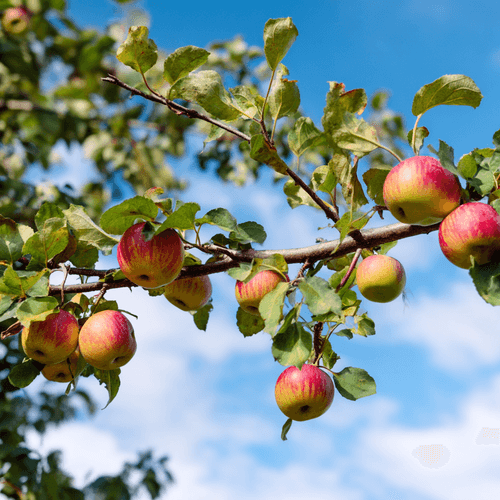
A close photo of apples

Overview

Overview before growing apples

Section titled “Overview before growing ”

Lumière

At least 6-8 hours of direct sun per day for good flowering and fruiting.

Eau

Regular deep watering, especially in the first years and during dry spells, keeping soil evenly moist but never waterlogged.

Température

Best growth in temperate climates with cool winters and mild summers around 60-75°F (15-24°C).

Espacement

Plant standard trees 15-20 ft (4.5-6 m) apart and dwarf trees 8-12 ft (2.5-4 m) apart for good airflow.

Temps de culture

Expect the first real harvest 3-5 years after planting a young grafted tree, with yields increasing as the tree matures.

Climat requis

Apples prefer a temperate climate with winter chill, full sun, and well-drained, slightly acidic to neutral soil.

Rendement des plantations

Mature dwarf trees can give 10-20 kg per tree, while larger trees can produce much more under good care.

Culture en pot

Choose a dwarf variety in a large container with rich, free-draining soil, full sun, regular watering, and annual pruning.

Growing requirements

What supplies do you need to grow apples ?

Section titled “What supplies do you need to grow ?”
  • Young grafted apple tree or suitable rootstock
    Required
  • Loamy, well-drained soil or quality fruit tree compost
    Required
  • Balanced slow-release fertilizer for fruit trees
    Required
  • Mulch (compost, bark, or straw) for moisture retention
    Required
  • Sturdy stake and soft ties to support young trees
    Optional
  • pH test kit to keep soil around 6.0-7.0
    Optional
  • Pruning shears for shaping and removing dead wood
    Optional
  • Organic pest and disease controls (traps, sprays, barriers)
    Optional
Planting

Calendrier de plantation

JAN
FÉV
MAR
AVR
MAI
JUN
JUL
AOÛ
SEP
OCT
NOV
DÉC

Meilleur moment pour planter

Encore possible de planter

Pas recommandé

Planter apples à l'extérieur

  • 1Choose a sunny, sheltered spot with well-drained soil and enough space for the mature tree size.
  • 2Dig a planting hole about twice as wide as the root system and loosen the soil at the bottom.
  • 3Soak bare roots if needed, then place the tree so the graft union sits a few inches above soil level.
  • 4Backfill with native soil mixed with compost, gently firming to remove air pockets around the roots.
  • 5Water deeply after planting and create a shallow basin to help direct water to the root zone.
  • 6Mulch around the base, keeping mulch a few inches away from the trunk, and stake the tree if exposed to wind.

Conseil pro: Plant while the tree is dormant in cool weather and avoid burying the graft union to keep dwarf trees from becoming full size.

Planter apples à l'intérieur

  • 1Select a dwarf or patio apple variety and a large container with good drainage holes.
  • 2Fill the pot with a high-quality, free-draining potting mix enriched with compost.
  • 3Position the tree in the center of the pot with the graft union above the soil surface.
  • 4Backfill around the roots, firm the soil gently, and water thoroughly to settle everything in place.
  • 5Place the container in full sun and rotate it occasionally so all sides receive even light.
  • 6Check moisture often, watering when the top inch of soil feels dry, and refresh mulch each season.

Conseil pro: Container-grown apples dry out quickly, so monitor watering closely during hot, windy weather to avoid stress and fruit drop.

Plant care

How to take care of apples ?

Section titled “How to take care of ?”

Arrosage

Water deeply and consistently, especially in the first 2-3 years, letting the topsoil dry slightly between waterings but never allowing prolonged drought or standing water.

Fertilisation

Feed in early spring with a balanced, slow-release fruit tree fertilizer, then lightly top up after flowering if growth is weak, avoiding heavy nitrogen that encourages leaves over fruit.

Taille

Prune during late winter while dormant to remove dead, crossing, or inward-growing branches and to shape an open, airy canopy that lets in plenty of light.

Harvesting

Temps

Most apple varieties are ready from late summer to late fall, several years after planting once trees begin bearing regularly.

Signes

Fruit has full variety-specific color, feels firm but comes away easily when lifted and twisted from the spur.

Harvest apples on a dry day by lifting the fruit upward and gently twisting so it detaches with the stem intact, then handle carefully to avoid bruises and store sound fruits in a cool, dark, well-ventilated place.

Problems & solutions

Common issues when growing apples

Section titled “Common issues when growing ”

Apple scab

Olive-brown spots and scabby patches on leaves and fruit.

Rake and remove fallen leaves, choose resistant varieties when possible, prune for good airflow, and use approved fungicides or organic sprays at bud break if the disease is recurrent.

Powdery mildew

White, powdery coating on young leaves, shoots, and buds.

Cut out and destroy infected shoots, avoid excess nitrogen, water at the root zone, and apply suitable fungicidal sprays early in the season if necessary.

Codling moth

Small holes in fruit and tunnels with brown frass inside apples.

Use pheromone traps to monitor and disrupt mating, remove and destroy infested fruit, and apply targeted biological or organic treatments at the correct timing after petal fall.

Aphids

Clusters of soft insects on shoot tips and curled, distorted leaves.

Encourage beneficial insects like ladybirds, wash small infestations off with water, and use insecticidal soap or horticultural oil when populations become heavy.